If you grew up in a traditional Indian household or spent time in one you may have a memory that you cannot quite name.
A grandmother doing something small after eating. A particular smell. A ritual that seemed to have no explanation beyond this is what we do. Something involving oil, or seeds, or a specific order of things that happened at the end of a meal before anyone left the table.
These post-meal rituals existed across almost every region of India. The specific practice varied South Indian households observed different traditions from North Indian ones, and those differed again from Gujarati or Bengali customs. But the underlying logic was consistent across all of them: the meal was not considered complete when the last morsel was eaten. There was something that came after. A deliberate, small act of closure that supported what the body would do next.
Most of those rituals are gone now. Not abandoned dramatically just quietly lost in the shift toward faster meals, nuclear families, and kitchens where the connection between food and health has been handed over to labels and supplements.
This is an attempt to recover some of them. Not as nostalgia. As nutrition.
What Ayurveda Said About the Meal’s Final Act
The ancient physicians were precise about the period immediately following a meal. Charaka Samhita one of the foundational Ayurvedic texts devoted considerable attention to what it called ahara vidhi visheshayatana: the specific rules governing how food should be eaten and what should follow.
The reasoning was systematic. Digestion, in Ayurvedic understanding, is governed by Agni the digestive fire. A meal activates Agni, but the process of digestion continues for several hours afterward. The post-meal period was considered critical because it set the conditions under which that continued digestion would happen. Too much activity immediately after eating scattered the digestive energy. Certain foods consumed after a meal supported Agni’s work. Others disrupted it.
Sesame was central to this understanding. Til sesame seed and its oil appears repeatedly across Ayurvedic texts as something to be consumed after eating, not as a meal component but as a specific digestive and oral health support. The properties attributed to it were precise: it was said to be ushna (warming), snigdha (unctuous, lubricating), and balya (strength-giving). It was believed to support the downward movement of Vata the energy governing elimination and gut motility which is exactly what the body needs to move food efficiently through digestion.
Coconut, similarly, appears in post-meal contexts across South Indian and coastal traditions not as a dessert but as a digestive. The small piece of coconut or the thin coconut-based preparation eaten at the end of a meal in Kerala, Tamil Nadu, and coastal Karnataka was not an accident of taste. It was deliberate medicine.
The Rituals, Region by Region
Oil Pulling After Meals Kavala Graha
This practice is most commonly discussed as a morning ritual. But the original Ayurvedic prescription for kavala the swishing of oil in the mouth was also described in post-meal contexts, specifically as a way to clear the oral cavity of food particles and pathogenic bacteria before they could establish themselves.
The mouth is the first stage of digestion. Amylase, the enzyme in saliva, begins breaking down starches the moment food enters. After a meal, residual starches and sugars coat the teeth and gum line creating an ideal environment for bacterial fermentation that Ayurvedic practitioners understood was connected to broader systemic health.
A brief swish of sesame or coconut oil after eating even one to two minutes was observed in many traditional households as a simple act of oral hygiene that was also understood to support digestive health. The mechanical action of swishing pulls food debris from between teeth. The antimicrobial properties of sesame’s sesamol and coconut’s lauric acid reduce bacterial load in the oral environment.
Modern dentistry has begun validating this with research multiple studies now confirm that oil pulling reduces Streptococcus mutans counts in saliva and decreases plaque indices comparably to chlorhexidine mouthwash, without the side effects.
Til Gud After Meals Sesame and Jaggery
Across Maharashtra, Gujarat, Karnataka, and parts of Rajasthan, the combination of sesame seeds and jaggery was eaten at the end of a meal a small quantity, almost like a punctuation mark rather than a dessert.
The nutritional logic is elegant. Sesame seeds carry lignans, zinc, calcium, and the antioxidant sesamol. Jaggery provides iron and acts as a mild digestive it is traditionally understood to support bowel regularity and reduce the heaviness that can follow a rich meal. Together, they deliver micronutrients in a form that requires minimal additional digestive effort.
Makar Sankranti brought this combination into public ritual til gud ghya, god god bola but the everyday post-meal version was quieter and more functional. A teaspoon of roasted sesame seeds with a small piece of jaggery, eaten after lunch or dinner, was considered standard practice in many households several generations ago. It has largely been replaced by packaged sweets, mouth fresheners, or nothing at all.
Coconut Sliver After Meals The South Indian Close
In many South Indian homes, particularly in Kerala and Tamil Nadu, a small piece of fresh coconut or a preparation made with grated coconut was eaten at the end of a meal as a matter of course.
The reasoning, as understood through both tradition and now nutrition science, is sound. Fresh coconut contains medium-chain triglycerides the same fats present in coconut oil that support gut health and are processed by the liver rapidly and efficiently. It also contains lauric acid with documented antimicrobial properties, and dietary fibre that supports the mechanical process of moving food through the digestive tract.
The coconut sliver after a meal was not dessert in the Western sense. It was the body’s closing instruction for digestion: warm, fatty, slightly sweet, grounding. It told the system that eating was complete.
Hing and Til Oil in Post-Meal Preparations
Across North India and particularly in Uttar Pradesh and Bihar, small post-meal preparations often a simple drink or a very small side incorporated asafoetida (hing) and sesame oil together. Hing is one of the most powerful carminatives in the Indian spice tradition it directly reduces gas and bloating by relaxing intestinal spasm. Combined with the lubricating properties of sesame oil, these preparations addressed the two most common complaints that arise in the hours following a large meal.
These did not survive the transition to urban kitchens because they required knowledge to prepare, smelled pungent in ways that apartment living discourages, and had no packaging or shelf space.
The Monsoon Relevance Why July Is When This Matters Most
Ayurvedic texts were not indifferent to season. The post-meal rituals involving sesame and coconut oil were specifically emphasised during Varsha Ritu the rainy season because this is when digestive capacity is weakest.
The logic: monsoon dampens Agni. Humidity slows the body’s internal heat. Digestion becomes sluggish, appetite becomes unpredictable, and the gut is more susceptible to the waterborne and food-contamination risks that spike during the rains. The post-meal rituals warming oil, digestive seeds, oral antimicrobials were not year-round casual suggestions. During monsoon, they were considered essential support for a system under seasonal stress.
In July 2026, with the rains fully arrived across most of India and kitchens cooking heavier, oilier monsoon foods pakoras, khichdi, hot chaas the argument for recovering even one of these practices is not abstract. It is seasonal medicine.
What Bringing This Back Actually Looks Like
None of this requires a dramatic change to how you eat.
After lunch or dinner tonight, try one of the following depending on what is already in your kitchen:
A teaspoon of roasted sesame seeds with a small piece of jaggery. Eat slowly, after the meal is complete.
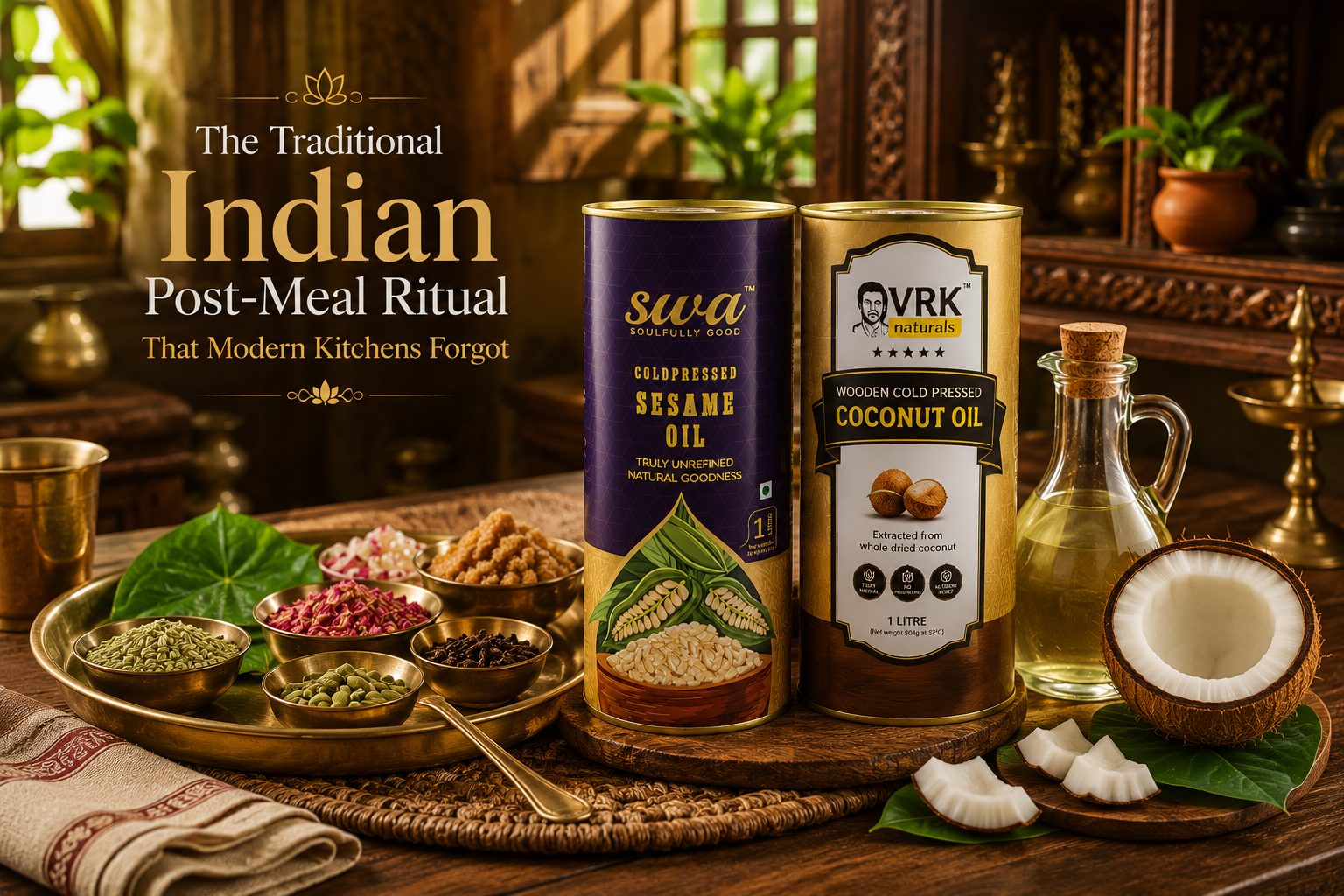
A brief oil pull one tablespoon of cold-pressed sesame or coconut oil, swished gently for two minutes, then spat out. Not while doing something else. As a deliberate act of closure.
A thin sliver of fresh coconut eaten slowly at the end of a meal, the way it would have been eaten in a coastal South Indian home a generation ago.
These take less than three minutes. They cost almost nothing. They ask only that you treat the end of a meal as part of the meal not as the moment you pick up your phone.
The Deeper Loss
What these rituals represented was not just functional nutrition. They represented a framework in which eating was understood as a complete act with a beginning, a middle, and an end. The beginning was preparation what you cooked with, how it was seasoned. The middle was the meal itself. The end was the small act of supporting what came next.
Modern meals have a beginning and a middle. The end has been replaced by the dinner table becoming a work desk, or the television going on, or simply leaving the table because there is somewhere else to be.
The oils that anchored these post-meal practices sesame, coconut are the same oils that have always been in an Indian kitchen. They did not disappear. The knowledge of what to do with them after eating did.
That knowledge is recoverable. It takes only the decision to try one small thing tonight, after the last roti, before the plates are cleared.