Walk into any Indian kitchen and there is a good chance you will find a sunflower oil bottle on the shelf. It is the country’s most widely used cooking oil. Doctors recommend it. Advertisements show happy, active families. The label says rich in Vitamin E and good for the heart.
All of that is technically true of the sunflower seed. What happens between the seed and the bottle most people bring home is a different story entirely.
The Sunflower Seed Is Genuinely Remarkable
Start here, because the original ingredient deserves credit.
Sunflower seeds are one of the richest natural sources of Vitamin E on the planet. They contain linoleic acid, an omega-6 fatty acid essential for cell membrane structure. They have natural phytosterols that compete with cholesterol for absorption in the gut, which is why sunflower-derived oil genuinely does support heart health when it is kept in something close to its natural form.
The seed is not the problem. The process is.
What Refining Actually Does to the Oil
To produce the clear, light, odourless sunflower oil that fills supermarket shelves, the seed goes through a series of industrial steps that would be alarming if printed on the front of the bottle.
First, the seeds are crushed and treated with chemical solvents typically hexane to extract every last drop of oil. The crude extract is then degummed, bleached with activated clay or acid, and deodorised under high-pressure steam at temperatures between 180°C and 230°C. Finally, it is filtered until it looks neutral enough to be acceptable.
At the end of that process, here is what has changed:
Vitamin E is largely destroyed. The very nutrient that made sunflower oil worth talking about in the first place is heat-sensitive. Temperatures above 120°C begin degrading tocopherols the form of Vitamin E in sunflower seeds. By the time refining is complete, studies have shown Vitamin E losses of up to 70% compared to cold-pressed equivalents.
The fatty acid profile is damaged. Linoleic acid is a polyunsaturated fat, which means it is structurally delicate. Under high heat and chemical treatment, polyunsaturated fats oxidise a process that produces free radicals and potentially harmful compounds including aldehydes. You are cooking with an oil that has already begun to oxidise before it even reaches your pan.
Natural antioxidants are gone. Sunflower seeds contain polyphenols and other plant compounds that protect the oil from rancidity and protect your cells from oxidative damage. Refining strips these out in favour of a longer commercial shelf life and a neutral flavour profile.
What you get is an oil that fries well, stores for months, and does exactly nothing nutritionally useful. The marketing is selling you the seed. The bottle is giving you the aftermath of an industrial process.
Wood-Pressed Sunflower Oil: What Stays Intact
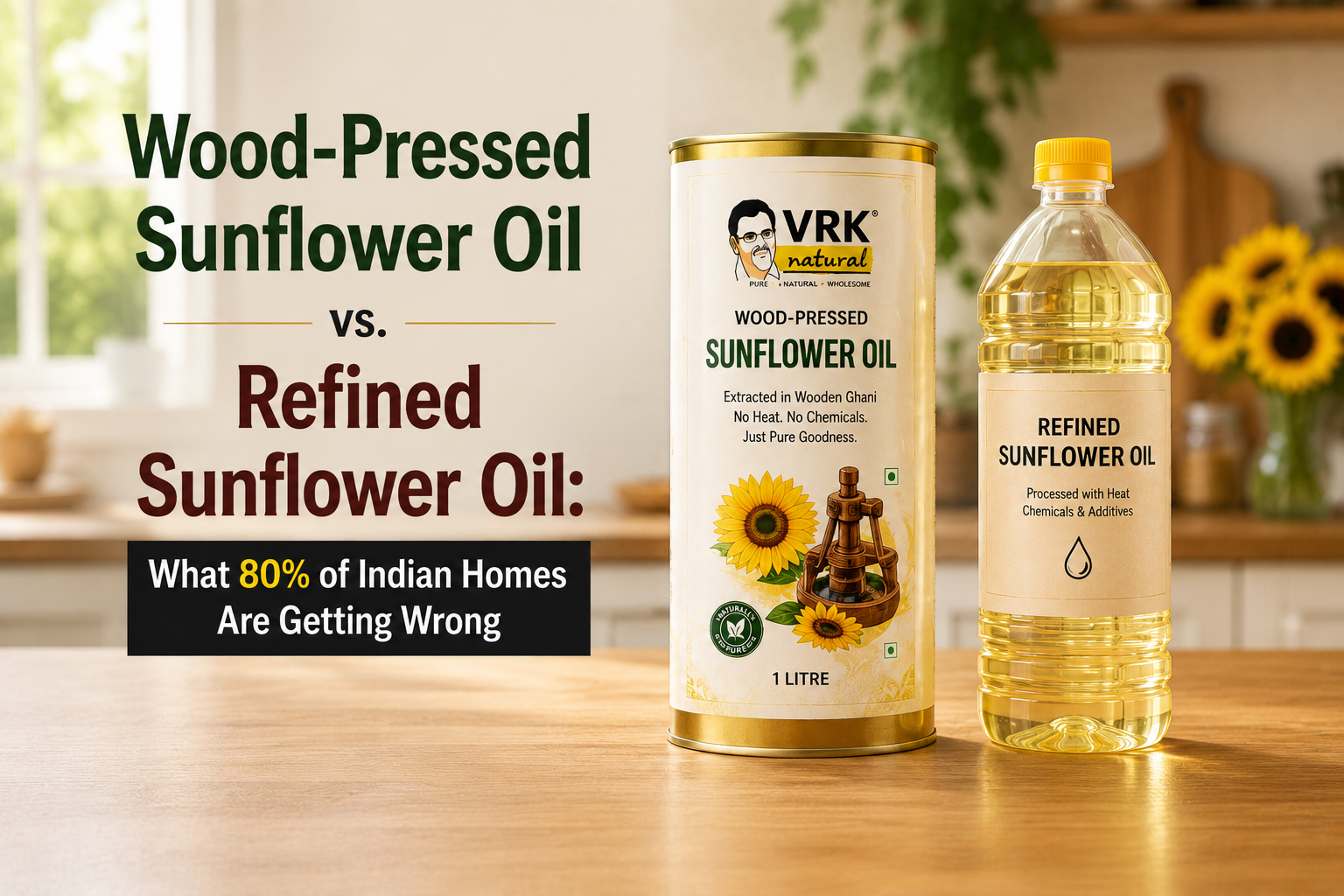
Wood cold-pressed sunflower oil is extracted using traditional mechanical pressing at low temperatures below 50°C with no chemical solvents and no bleaching or deodorising steps.
The oil that comes out the other side looks different. It has a natural pale gold colour. It smells faintly of sunflower seeds. It is not perfectly clear.
And it retains what matters:
The Vitamin E is intact genuinely, not just as a label claim. The linoleic acid is undamaged and in a form your body can actually use. The natural phytosterols are present. The polyphenols have not been bleached out. The oil has not already begun oxidising before you open the bottle.
This is the version your body was expecting when it signed up for sunflower oil.
The Smoke Point Conversation Because Someone Will Bring It Up
The standard argument against cold-pressed oils is that they have a lower smoke point and are therefore unsuitable for Indian cooking, which involves high-heat frying and tempering.
For sunflower oil, this argument is overstated.
Wood-pressed sunflower oil has a smoke point of approximately 160°C–180°C. Most home cooking sautéing vegetables, making a tadka, stir-frying, preparing a curry base happens well within that range. A domestic gas flame on medium heat brings a pan to around 140°C–160°C. You would need sustained high flame with a very thin layer of oil to push past the smoke point in everyday cooking.
Where wood-pressed sunflower oil is not the right choice: continuous deep frying at commercial scale, or recipes that require the oil to be very hot for extended periods. For those specific uses, groundnut oil is a better cold-pressed option given its higher smoke point.
For everything else which is the overwhelming majority of what happens in an Indian home kitchen wood-pressed sunflower oil works perfectly well and delivers nutritional value that the refined version simply cannot.
Why the Refined Version Became the Default
It is worth understanding how refined sunflower oil became so dominant, because it did not happen by accident.
Refined oil is cheaper to produce at scale. It has a dramatically longer shelf life oxidation-damaged oil that has already lost its natural antioxidants paradoxically stays fresh looking for longer because there is nothing left to further react. It looks cleaner. It fries without smoking at lower temperatures because its delicate compounds have already been destroyed.
In short, it is optimised for the supply chain, not for the person cooking with it.
Cold-pressed oils, by contrast, have a shorter shelf life, a natural sediment, a real smell, and a slightly higher price all of which are signs of an oil that still has something in it. These were interpreted as flaws. They are not. They are evidence of an extraction process that left the oil alone.
Reading the Label Without Being Fooled
One thing worth knowing before your next purchase: cold-pressed on an Indian label is not a regulated claim the way it is in some other markets. Brands can and do use the term loosely.
Here is what to look for instead. VRK Naturals’ wood cold-pressed sunflower oil, for instance, specifies the extraction method as traditional wooden mill pressing and is packed in tin containers which protect the oil from light and heat far better than plastic. Check for: a natural colour rather than crystal clarity, an aroma that smells like the actual seed, a single ingredient on the label, and packaging that takes preservation seriously.
If an oil claiming to be cold-pressed looks and smells like water, ask what was done to make it that way.
One Number Worth Sitting With
The average Indian household uses approximately 15–18 litres of cooking oil per year. Every drop of that oil either delivers something useful to your body or simply carries heat to your food.
Over a year, over five years, over the course of a family’s life that is a significant cumulative difference between oil that has retained its nutritional value and oil that has had it refined away.
The switch from refined sunflower oil to wood-pressed sunflower oil is not a dramatic lifestyle change. It is a small, specific correction to something that has quietly been wrong in most Indian kitchens for decades.