Nobody thinks about cooking oil as a parenting decision.
You spend hours reading about which school to pick, which hobby class develops better focus, which milk has the right calcium ratio. And then you fry the evening snack in whatever oil is on the shelf the one with the heart symbol on the pack and a price that made sense at the time.
That is not a criticism. It is just how the conversation around children’s nutrition has been shaped. Vegetables, protein, dairy these get the attention. The cooking medium that touches every single one of those foods, every single day, has somehow stayed invisible.
It should not be invisible. Because between the ages of 2 and 12, your child’s brain is doing something extraordinary and what you cook with has a direct say in how well that process goes.
What Is Actually Happening Inside a Growing Brain
The human brain reaches roughly 90% of its adult size by age 5. But size is not the whole story. What matters more is the quality of the connections being built during that period the neural pathways that will determine how well your child thinks, focuses, remembers, and regulates emotion for the rest of their life.
That construction project runs on fat.
The brain is nearly 60% fat by dry weight. The myelin sheath the protective coating around nerve fibres that allows signals to travel quickly and accurately is made primarily of fatty acids. When that sheath is well-formed, information moves fast and cleanly between neurons. When it is not, signals slow down, misfire, or get lost.
Omega-3 and omega-6 fatty acids are the primary building blocks of both myelin and the cell membranes of neurons. The body cannot manufacture these on its own. They have to come from food. And unlike adults, who have years of stored reserves to draw on, children need a fresh, consistent supply arriving daily to keep up with how rapidly their brains are developing.
What Refined Oil Actually Does (and Does Not Do)
Most Indian households cook with refined sunflower, soybean, or palmolein oil. These oils are cheap, widely available, and heavily marketed as “light” or “heart-healthy.”
Here is what the refining process involves: seeds are crushed and treated with chemical solvents to extract maximum yield, then the crude oil is bleached, deodorised, and heated to temperatures well above 200°C to make it look and smell neutral.
Every step of that process destroys something useful. The Vitamin E is stripped. The naturally occurring antioxidants are gone. The delicate polyunsaturated fatty acids the ones your child’s brain actually needs are damaged or converted into forms the body cannot use effectively.
What remains is a calorie-dense liquid that keeps food from sticking to the pan. It is not nourishing a developing brain. It is simply cooking food.
What a Wood-Pressed Oil Does Differently
Wood cold-pressed oils are extracted the old way slow pressure, low temperature, no chemical solvents. Nothing is added. Nothing useful is destroyed.
The result is oil that still contains its full complement of fatty acids, fat-soluble vitamins, and antioxidants in the form that your child’s body can actually absorb and use.
Sesame oil is particularly high in zinc, which plays a direct role in neurotransmitter function and cognitive development. Zinc deficiency in children is consistently linked to reduced attention span and slower learning. It is also rich in sesamol, a potent antioxidant that protects brain cells from oxidative damage.
Groundnut oil provides a significant source of Vitamin E and oleic acid a monounsaturated fat that supports the structural integrity of brain cell membranes. Research increasingly links adequate oleic acid intake in childhood with better memory and learning outcomes.
Coconut oil contains medium-chain triglycerides that are metabolised differently from long-chain fats. Instead of going through the usual digestive cycle, MCTs are converted rapidly into ketones an alternative fuel source that the brain can use directly and efficiently, particularly useful for children with inconsistent energy levels through the school day.
None of this requires supplements. No special powders. No additional expense beyond switching the oil in the kitchen.
The Tiffin Box Thought Experiment
Think about what your child eats on a typical school day. Paratha in the morning, cooked in oil. Dal rice at lunch, with a tadka. An evening snack perhaps a stir-fried vegetable or a simple egg dish. Maybe a roti at dinner with sabzi.
Every one of those meals is cooked in oil.
If that oil is refined, every meal is a missed opportunity to deliver fatty acids, vitamins, and antioxidants to a brain that is actively building itself.
If that oil is wood-pressed genuinely cold-pressed, not relabelled refined oil every meal becomes a small, consistent contribution to better attention, memory, and cognitive resilience. Not dramatically or overnight. The way nutrition works is slow and cumulative. But so is brain development.
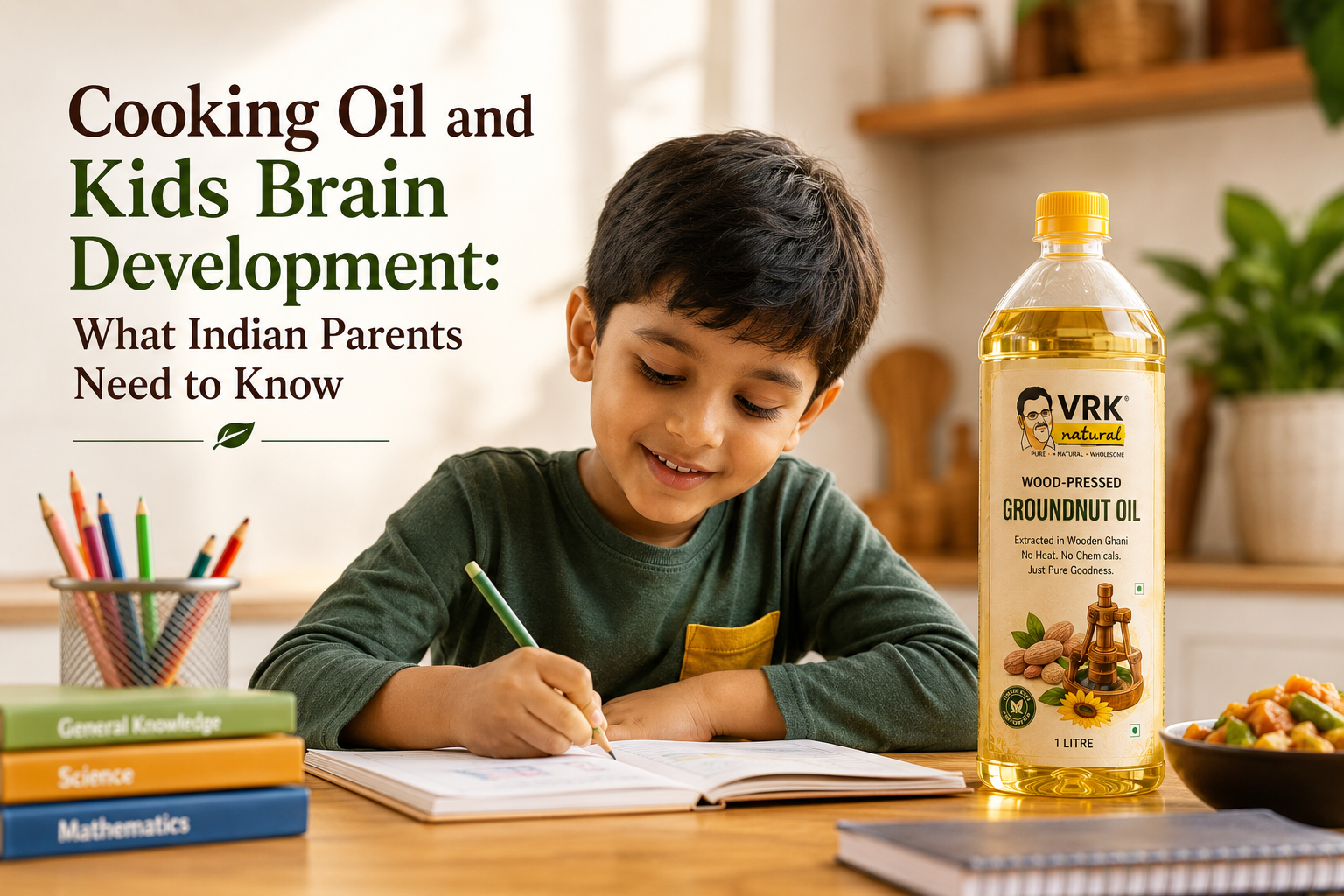
This is actually where VRK Naturals’ wood cold-pressed sesame, groundnut, and coconut oils fit naturally into a family kitchen not as a health trend, but as the most straightforward way to make sure every meal is carrying something real to the table.
A Note on What to Look for on the Label
“Cold-pressed” on a label in India means almost nothing without further scrutiny. The term is not tightly regulated, and many oils labelled as cold-pressed are partially refined or blended.
A genuinely wood-pressed oil will have a natural colour pale gold to deep amber depending on the seed. It will have a distinct aroma. It will not be crystal clear. If the oil smells of nothing and looks like water, the nutrients have been processed out.
The ingredient list should have one item. Just the seed.
Check for tin packaging if possible it blocks light and heat far better than plastic, which is one of the fastest ways a good oil goes bad before it reaches you.
The Part That Does Not Make Headlines
Here is something that rarely appears in parenting articles about brain development.
The foods that are highest in DHA and omega-3 fatty acids the ones most directly linked to cognitive development are things like fatty fish, walnuts, and flaxseed. Most Indian children do not eat these daily. Some do not eat them at all.
In that context, the cooking oil becomes more important, not less. It is the one fat source that is present in every meal, without exception, every single day. If it is delivering nutrients, it is doing so consistently and at scale. If it is not, that gap quietly accumulates over years.
You cannot control everything about how your child’s brain develops. Genetics, sleep, stress, the quality of their school these are complex variables.
The oil you cook with tonight is not complex. It is a simple choice. And it is one you make every day, which means it compounds in whichever direction you choose.